*Equal contribution †Corresponding authors
Cross-embodiment navigation is a key challenge in embodied intelligence. Due to differences in embodiment, the same visual observation may imply different actions for different agents, making prediction ambiguous when relying solely on vision. Existing studies mainly rely on reinforcement learning, which requires large-scale interaction and careful reward design, making it difficult to support scalable pretraining and real-world adaptation. In contrast, imitation-learning-based approaches remain limited. To address these challenges, we propose an imitation-learning-based embodiment-aware navigation framework with a modular multi-stage design. In pretraining, we construct a cross-embodiment navigation dataset from Internet videos and introduce embodiment geometry as conditional tokens to reduce action ambiguity under the same observation. In fine-tuning, we design a multimodal information injection mechanism based on a decoupled architecture. Specifically, we design a trajectory augmentation strategy to generate high-risk samples, which are used to train spatial perception and risk-aware correction separately, thereby explicitly incorporating embodiment geometry for safe navigation. Experimental results show that the proposed method effectively improves navigation performance across different embodiment settings, demonstrating the effectiveness of incorporating embodiment geometry into embodied navigation.
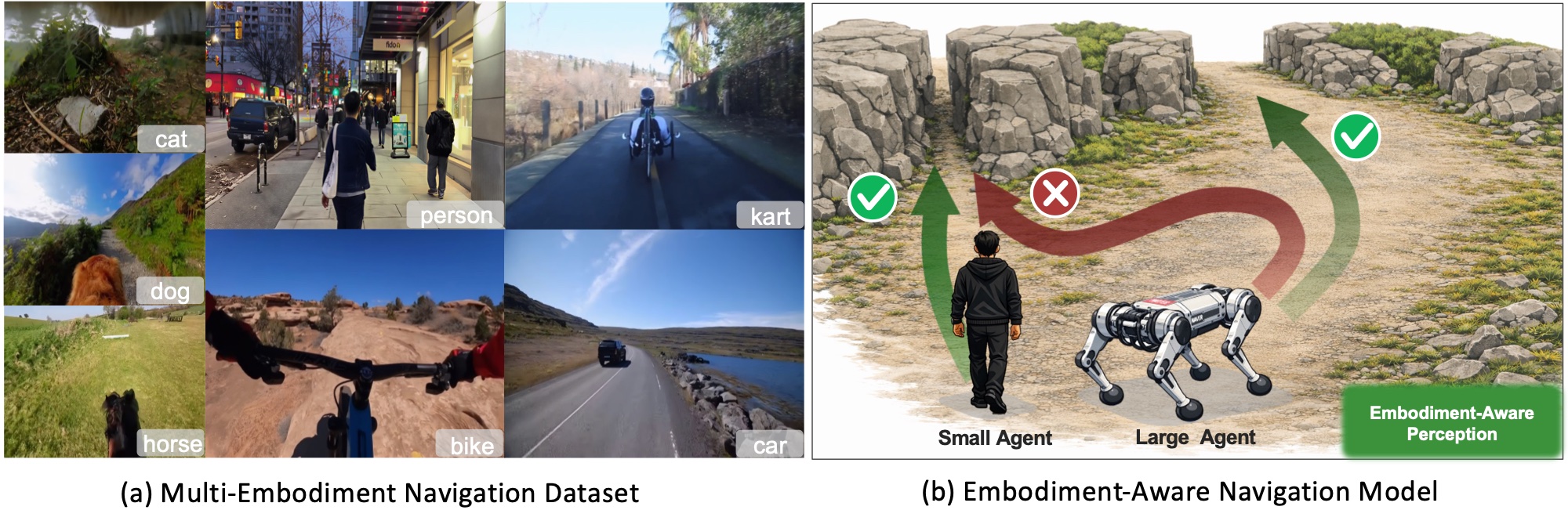
We collect roughly 1,000 hours of real-world first-person video from the Internet spanning eight embodiment categories — including people, cats, dogs, horses, bicycles, karts, and cars. Depth, trajectories, and camera intrinsics are annotated automatically with Depth-Anything-3; embodiment geometry is annotated per category. Navigation pretraining only requires scale consistency between trajectories and observations, not exact metric alignment, which makes web-scale video usable. Compared with existing datasets, ours offers by far the broadest embodiment coverage.
Comparison with existing navigation datasets. Our dataset covers eight embodiment categories — the broadest coverage among real-world first-person navigation datasets.
| Dataset | Embodiments | Hours | Source | Supervision | Camera |
|---|---|---|---|---|---|
| SCAND | 2 | 9 | Real | GT | Pinhole |
| TartanGround | 3 | ~40 | Synthetic | GT | Pinhole |
| LeLaN | 2 | 129 | Real | Pseudo | Fisheye |
| CityWalker | 2 | 2000 | Real | Pseudo | Pinhole |
| FrodoBots-2k | 2 | 2000 | Real | Pseudo | Fisheye |
| OmniVLA | 3 | 9500 | Real | Pseudo | Fish & Pin |
| Ours | 8 | 1000 | Real | Pseudo | Pinhole |
EA-Nav takes an image sequence, the current depth observation, an egocentric goal, and a 4-dimensional embodiment vector m = [Lb, Wb, Hb, Pmax] (length, width, height, and maximum traversable height), and predicts an 8-step action sequence. The pipeline follows a prediction → perception → correction structure, with the three heads decoupled so that risk perception and correction can be trained on augmented high-risk trajectories.
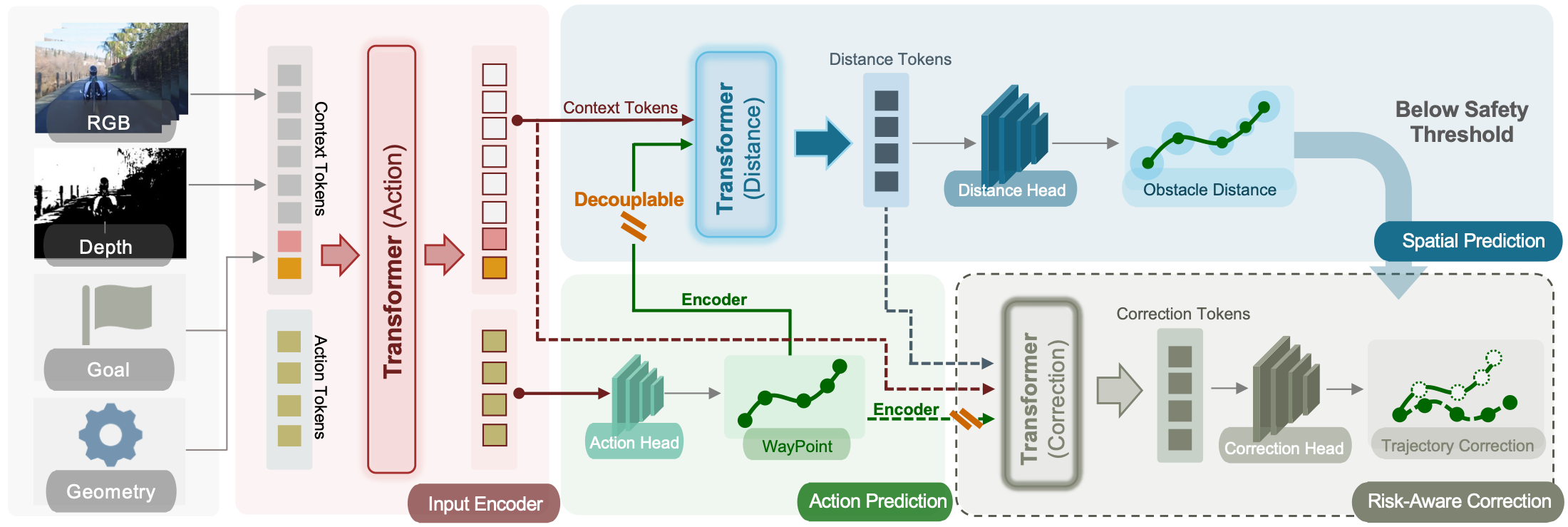
RGB (DINOv3-S) and depth (ConvNeXt-T) features, together with goal and geometry tokens, are projected into a shared 384-d space, giving 130 context tokens — far more than the 8–10 used by prior work. A unidirectional cross-attention lets the action query read this context without writing back to it, keeping the shared representation clean.
Decodes the action tokens into a sequence of linear and angular velocities, then integrates them into a local waypoint trajectory in the robot frame. The trajectory is re-encoded as an explicit spatial trajectory feature, giving the two downstream modules a geometric handle on where the policy intends to go.
Predicts the minimum obstacle distance at each waypoint and flags the trajectory as high-risk when it falls below the safety threshold δs = 0.5 m. It needs finer geometry-aware features than action regression, so its loss also updates the shared context — critical for convergence.
Triggered only above the risk threshold. Instead of regressing a new action sequence, it predicts a low-dimensional global yaw offset over 19 bins spanning [−45°, 45°] at 5° intervals, with multi-hot supervision capturing the one-to-many nature of recovery. At inference, the feasible bin with the smallest deviation is selected.
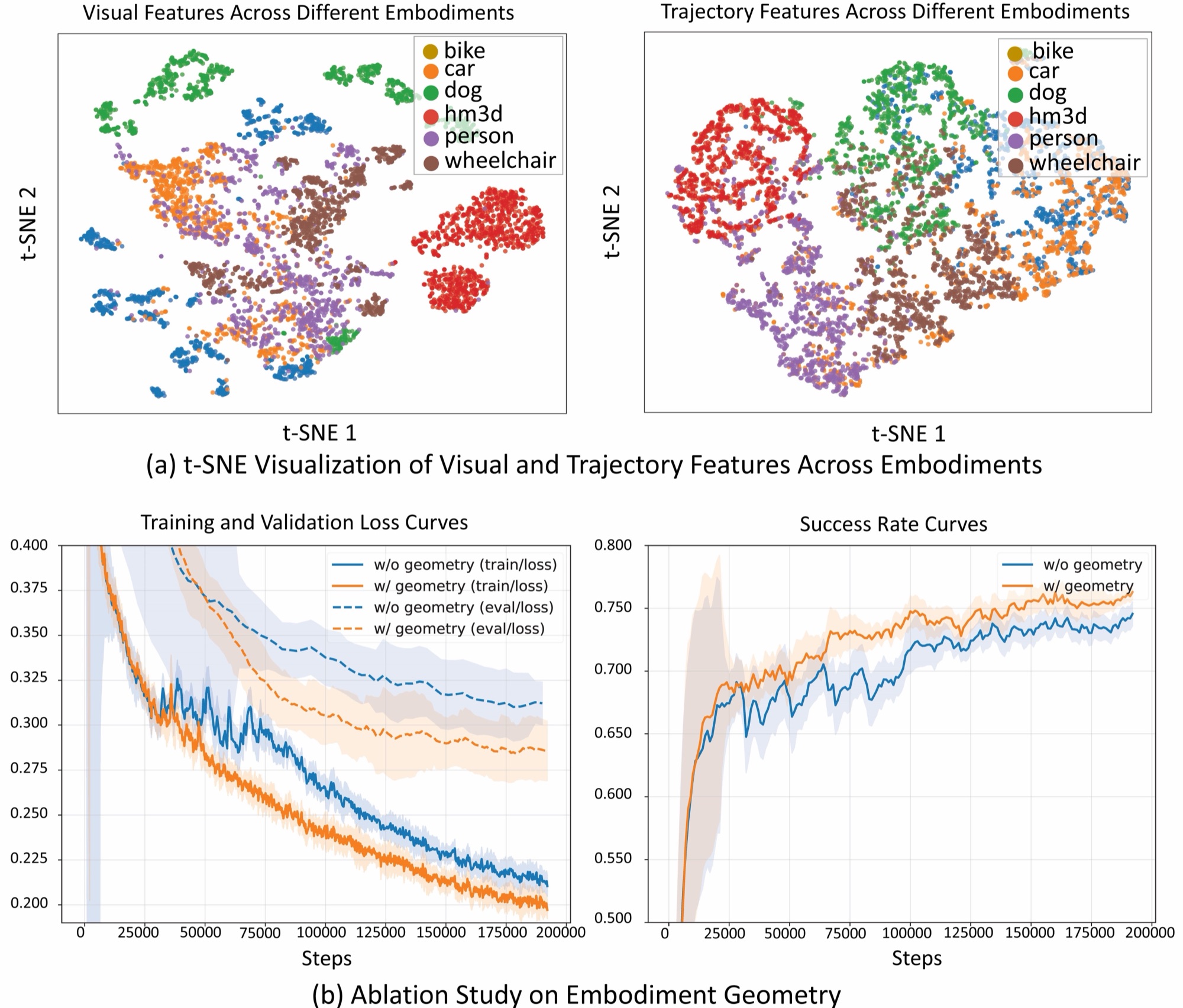
The t-SNE projection in Figure 3(a) makes the ambiguity concrete. Visual features from different embodiments overlap heavily — they organize by scene appearance rather than by who is moving, so a policy that sees only pixels cannot tell which behaviour is expected. Trajectory features separate into far cleaner per-embodiment groups: a car, a dog, and a person crossing the same space leave visibly different paths. The observation-to-action mapping is therefore one-to-many unless something identifies the body.
Embodiment geometry supplies exactly that. The ablation in Figure 3(b) toggles the geometry tokens with everything else held fixed. Conditioning lowers the training loss and — more tellingly — the validation loss, so the gain is not memorization: the model is resolving an ambiguity it previously had to average over. The success rate stays consistently higher, and the validation-loss gap persists to the end of the run rather than closing — the benefit is better-posed supervision, not merely faster optimization.
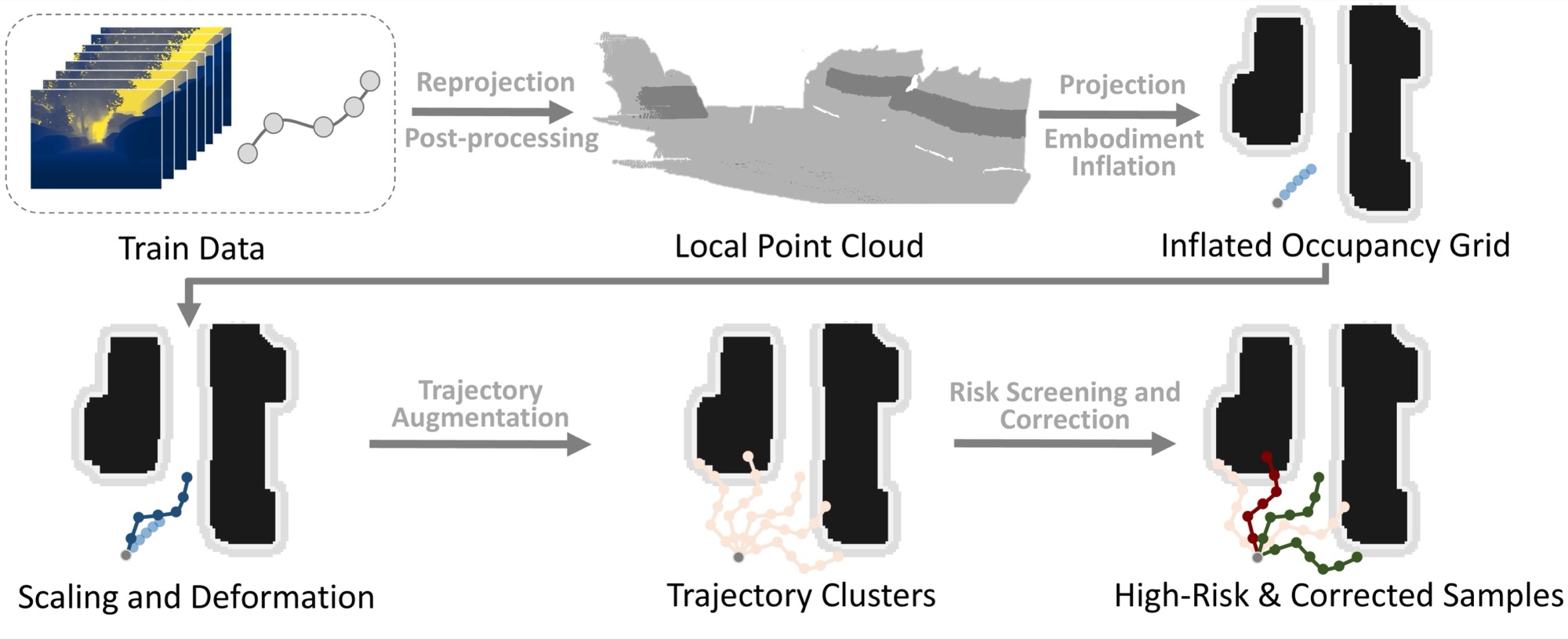
Real navigation datasets are recorded by competent operators, so they contain almost no collisions: the very samples that would teach risk perception and risk-aware correction are the ones that never appear. Fine-tuning on such data therefore leaves both downstream heads without supervision, and no amount of additional demonstration data fixes it — the missing behaviour is by construction absent from expert trajectories.
Our answer is to synthesize the missing samples offline, which first requires knowing where the free space actually is. For each clip we fuse short-horizon depth observations into a robot-centric point cloud, fit the ground plane with RANSAC, and inflate the remaining obstacles by the robot's own dimensions to obtain an embodiment-aware occupancy grid. Because the inflation is driven by the embodiment vector, the same scene yields a different notion of traversability for a cat, a horse, or a wheeled robot.
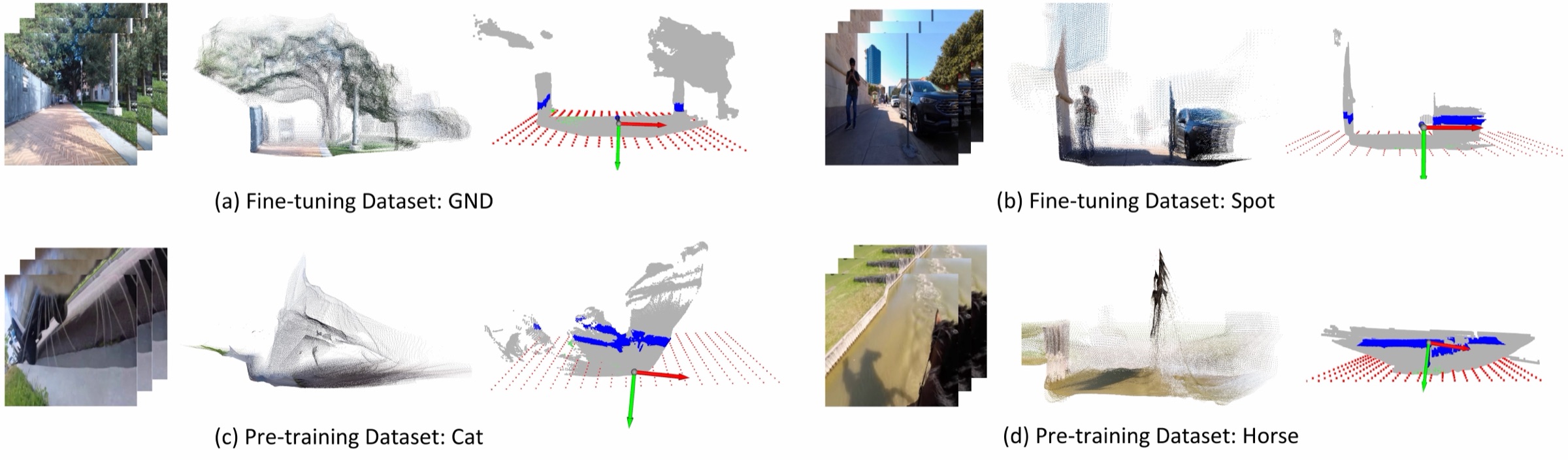
With the occupancy grid in place, we scale and rotate the expert trajectory to sweep a pool of candidates. Testing each against the grid splits the pool in two: colliding candidates become risk trajectories that supervise spatial perception, the collision-free ones define the feasible correction bins.
Each risk sample is thus paired with the recoveries that would have worked from that state — the basis for multi-hot supervision. All of this runs offline; none of it is needed at inference.
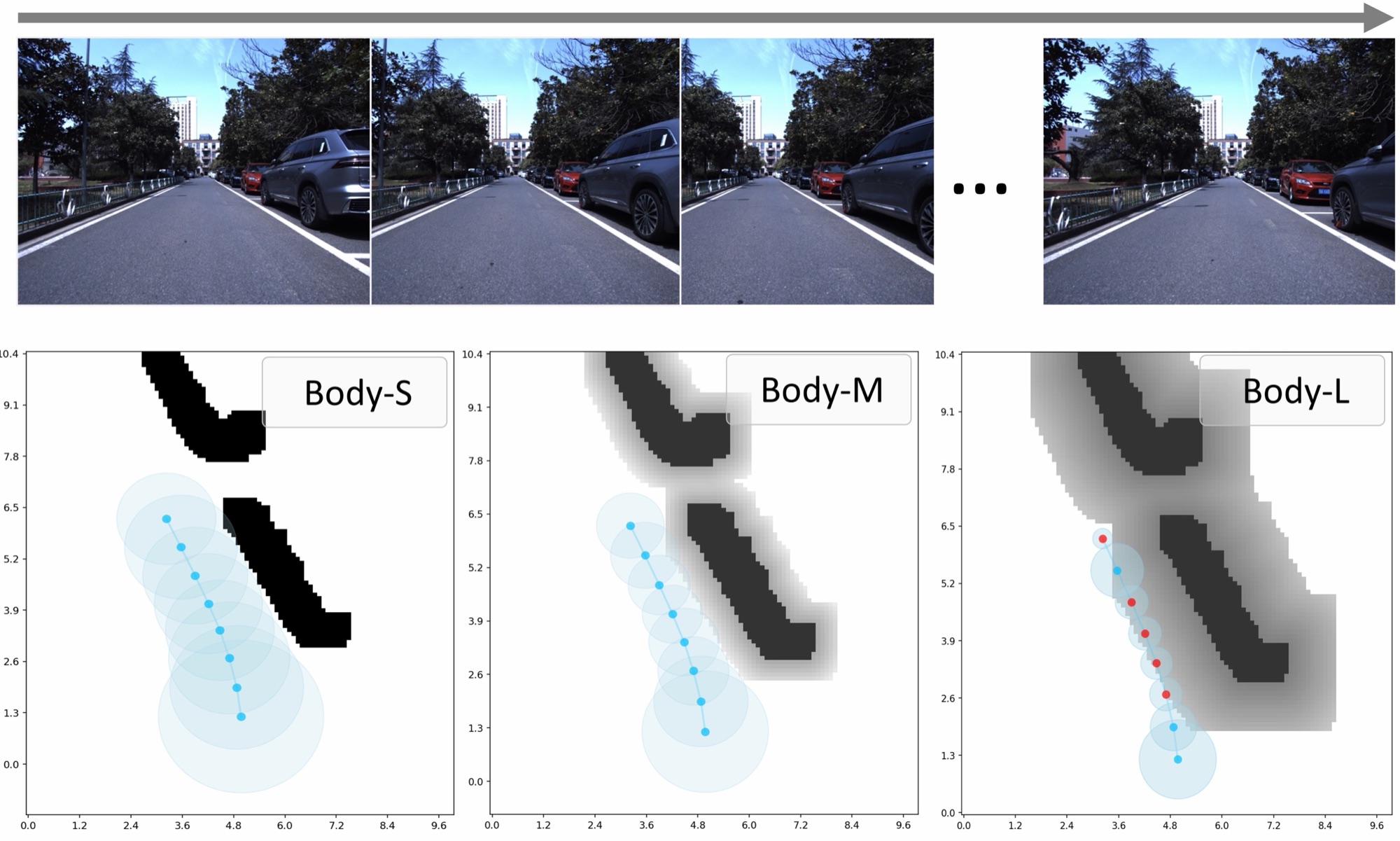
Trained on these samples, spatial perception reads clearance off the scene as a function of the body it is given. On the i2Nav dataset across five embodiment radii (0.5 m to 2.5 m, with Body-L lying outside the training range to test generalization), augmentation improves recognition of high-risk and collision samples by roughly 5× with almost no additional false alarms — the model becomes more cautious where it should be, not everywhere.
Qualitatively, the same gap is passable for Body-S, tight for Body-M, and blocked for the unseen Body-L, whose waypoints are flagged rather than driven through. Risk is read off the scene and the body, not the scene alone. Since correction only fires above the risk threshold, this reading also decides when the robot detours at all.
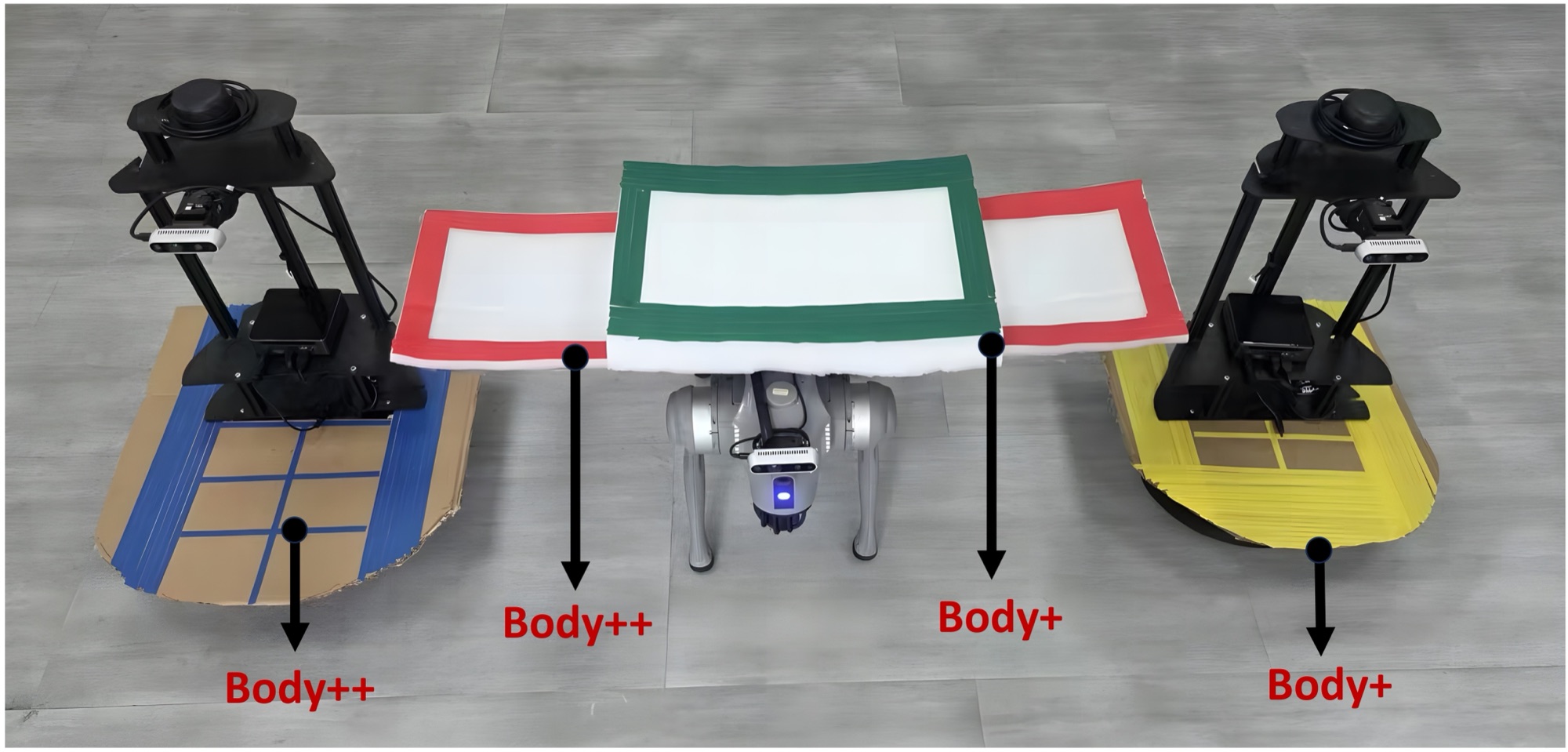
We deploy EA-Nav on two platforms with very different dynamics: a Unitree Go2 quadruped and a wheeled TurtleBot. To stress-test geometry awareness we deliberately do not swap robots — instead each platform is physically widened in two stages (Body → Body+ → Body++) by mounting rigid panels along its sides.
The camera and its mounting position stay untouched, so the visual observation is unchanged across the three settings and the only thing that differs is the embodiment vector m. Any change in behaviour is therefore attributable to geometry conditioning rather than to a shift in visual domain.
Evaluated on InternUtopia with NavDP assets across three difficulty levels. Adding the perception and correction modules improves average performance by roughly 31%, with the largest gains in the more cluttered Scene 2 and Scene 3.
Navigation results in simulation. Success rate (SR) and success weighted by path length (SPL) on InternUtopia with NavDP assets across three difficulty levels.
| Method | Scene 1 | Scene 2 | Scene 3 | |||
|---|---|---|---|---|---|---|
| SR ↑ | SPL ↑ | SR ↑ | SPL ↑ | SR ↑ | SPL ↑ | |
| iPlanner | 0.66 | 0.54 | 0.50 | 0.39 | 0.30 | 0.18 |
| NavDP | 0.73 | 0.63 | 0.60 | 0.52 | 0.56 | 0.41 |
| NoMaD* | 0.55 | 0.39 | 0.44 | 0.31 | 0.36 | 0.22 |
| ExAug* | 0.61 | 0.42 | 0.46 | 0.33 | 0.38 | 0.24 |
| Ours (w/o correction) | 0.62 | 0.51 | 0.45 | 0.35 | 0.43 | 0.31 |
| Ours (w/ correction) | 0.70 | 0.59 | 0.62 | 0.51 | 0.60 | 0.49 |
* denotes image-goal navigation methods.
Five trials per method per setting. From an identical observation, EA-Nav takes the narrow gap at Body and switches to the open detour as the body is widened to Body+ and Body++, with the route in (c) bending outward in proportion to the embodiment. Baselines see only the image, commit to the gap at every size, and collapse to a 100% collision rate at Body++.
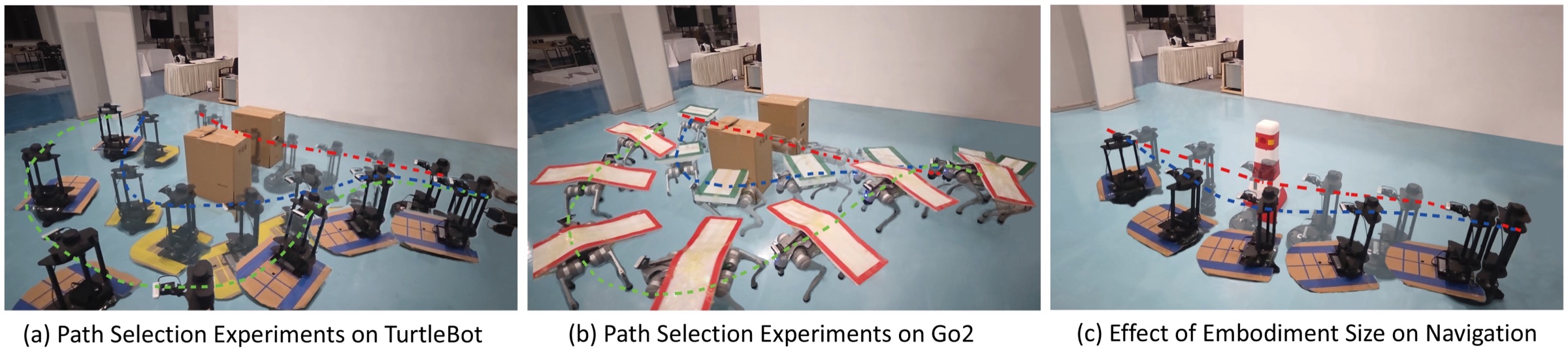
Navigation results on real robots. Success rate (SR) and collision rate (CR) on the Go2 and TurtleBot platforms as the embodiment is physically widened from Body to Body++.
| Robot | Method | Body | Body+ | Body++ | |||
|---|---|---|---|---|---|---|---|
| SR ↑ | CR ↓ | SR ↑ | CR ↓ | SR ↑ | CR ↓ | ||
| Unitree Go2 | iPlanner | 0.20 | 1.00 | 0.20 | 1.00 | 0.00 | 1.00 |
| NavDP | 0.60 | 0.60 | 0.40 | 0.80 | 0.00 | 1.00 | |
| NoMaD* | 0.20 | 0.20 | 0.00 | 0.40 | 0.00 | 1.00 | |
| ExAug* | 0.20 | 0.20 | 0.20 | 0.40 | 0.00 | 1.00 | |
| Ours | 0.80 | 0.20 | 0.60 | 0.20 | 0.60 | 0.00 | |
| TurtleBot | iPlanner | 0.60 | 0.40 | 0.40 | 0.80 | 0.00 | 1.00 |
| NavDP | 0.80 | 0.00 | 0.60 | 0.60 | 0.00 | 1.00 | |
| NoMaD* | 0.20 | 0.20 | 0.00 | 0.60 | 0.00 | 0.60 | |
| ExAug* | 0.20 | 0.20 | 0.20 | 0.60 | 0.00 | 0.20 | |
| Ours | 0.60 | 0.20 | 0.60 | 0.40 | 0.40 | 0.20 | |
SR: success rate. CR: collision rate. Five trials per method per setting.
Simulation. Navigation in InternUtopia across difficulty levels.
Real world. Deployment on the Go2 and TurtleBot platforms.
Conclusion. We present an imitation-learning-based navigation framework that treats embodiment geometry as a first-class input rather than an afterthought for a downstream planner. Pretraining builds a cross-embodiment dataset from Internet videos and injects geometry as conditional tokens; fine-tuning adds risk trajectory augmentation and a decoupled architecture so that spatial perception and risk-aware correction can be trained on synthesized high-risk samples. The resulting policy adapts its route to the body it is driving, and keeps navigating at embodiment sizes where every baseline collapses to a 100% collision rate.
Limitation. Our formulation describes the embodiment with a compact geometric vector, leaving out kinodynamic factors such as turning radius and acceleration limits; deployment therefore remains limited on embodiments whose motion patterns differ substantially from those seen in training, even when their geometry is similar. Future work will incorporate richer embodiment attributes, so that a policy can reason not only about how much space a body occupies but also about how that body is able to move.
@article{zhang2026ea,
  title={EA-Nav: Learning Safe Visual Navigation Policies with Embodiment Awareness},
  author={Zhang, Jialu and Du, Yong and Guo, Xianda and Sun, Shunwang and Liu, Xinqi and Sun, Yue and Lu, Guodong and Sui, Wei and Li, Jituo},
  journal={arXiv preprint arXiv:2607.19880},
  year={2026}
}